Aspirants to Deputy Court Clerk, Legal Typist, or Judicial Assistant positions through county or municipal civil service require high accuracy and speed under pressure. Court clerks record arraignments, transcribe judge findings, issue summonses, and file legal motions. Because a single misplaced semicolon or mistyped docket number alters official judicial records, judicial boards demand a verified speed of 40 to 45 Net Words Per Minute on legal transcription passages.
The practice engine above evaluates your speed against real court reporting standards. If legal abbreviations and case citations disrupt your flow, consistent typing practice online will train your muscale memory to handle complex punctuation without losing rhythm.
Table of Contents
The Structural Anatomy of a Court Typing Test
Civilian typing tests rely on conversational sentences. Courthouse examinations, however, present formal transcripts, legal codes, and statutory citations. Typing through a judicial exam means navigating three specific obstacles:
- Case Docket Identifiers: Passages frequently incorporate strings like Civil Action No. 26-CA-00418 or State v. Henderson, et al. These combinations require sudden shifts from lowercase letters to capitals, hyphens, and top-row numbers. So you need mastery on all key bars of the keyboard.
- Heavy Punctuation Clusters: Legal text features frequent semicolons, quotation marks, section symbols, and parenthetical citations. Typists who hunt for symbols lose two to three words of speed on every line.
- Unforgiving Error Formulas: Most municipal and state courts subtract full penalty words for any uncorrected spelling, spacing, or capitalization mistake. If your accuracy drops below 95%, your net score will not meet the passing line.
Curious how court standards compare to executive branch testing? Review our GS clerical 3 errors guide to see how federal evaluators apply strict error ceilings.
Frequently Asked Questions: Court Clerk Typing Exams
What is the standard passing speed for court clerks?
Most municipal and county superior courts require a baseline of 40 Net WPM for entry-level deputy clerks and 45 to 50 Net WPM for senior court recorders and courtroom clerks. Specialized legal transcription roles may demand 55 Net WPM.
Is the exam taken on paper or on a screen?
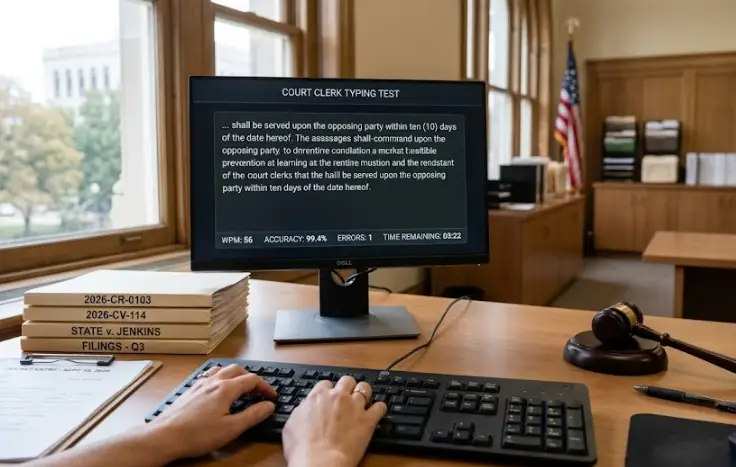
While older civil service tests relied on printed paper copies placed beside the monitor, modern courts primarily utilize split-screen software where the legal prompt appears directly above your typing field. Our simulator above replicates this digital layout.
Can I use the backspace key during an official test?
In most testing systems, backspace is permitted to correct errors in the active word. However, stopping to delete entire phrases wastes valuable seconds. Candidates who maintain a steady, disciplined rhythm almost always outscore fast typists who constantly stop to correct slips.
How long do typing certificates remain valid?
Courts that accept outside proficiency certificates (such as those from accredited adult education centers or workforce development boards) generally require the test to have been completed within the past 12 to 24 months.
If you are also applying for general government clerk openings, test your pacing on our federal administrative support tool to measure your endurance across general administrative memos.
Give Attention to Handling Legal Passages
Anchor Your Pinky Fingers for Symbols and Capitals
Legal terminology demands frequent capitalization and punctuation. Maintain disciplined touch typing form with your palms elevated. When you hit a capital letter, hold the opposite Shift key with your pinky rather than lifting your entire hand off the home row.
Treat Numbers as Words
When a passage presents a statutory code like Section 104(b), resist the urge to glance down at the keyboard. Practice reaching directly from the home row to the number row to keep your eyes locked on the text display.
Build Stamina with 5-Minute Blocks
Court exams do not evaluate 60-second sprints; they measure whether you can type accurately for a sustained period. Train in full five-minute intervals on our federal government 40 WPM simulator to ensure your wrists and fingers remain relaxed through the final minute.